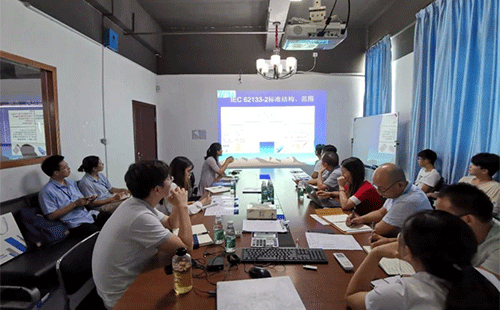
Center Certification & Testing International
With the advantages of lightness, flexibility and high energy density, polymer batteries are widely used in consumer electronics, smart wearables, portable devices and other fields. Their cross-border transportation and market circulation are inseparable from the compliance support of UN38.3 certification. As a special safety testing standard formulated by the United Nations for lithium batteries, UN38.3 certification is the core access certificate for polymer batteries to enter the international air, sea and land transportation systems, and also a key threshold to ensure the safety of the whole transportation process.
jointly implemented by Australia and New Zealand, and also a core access certificate for wireless microphones to enter the markets of the two countries. This certification integrates electrical safety, electromagnetic compatibility (EMC) and radio frequency compliance requirements, replacing the previous scattered certification system in the region, and has become an important standard for judging whether audio radio frequency equipment can be legally circulated.
For toy remote control car products planning to enter the Australian and New Zealand markets, RCM certification is not an optional additional qualification, but a mandatory access threshold for entering the local markets. RCM certification integrates multiple core requirements such as electrical safety and electromagnetic compatibility, covering categories such as electric toys and small electric appliances. Toy remote control cars are naturally included in the scope of certification supervision due to their built-in motors, circuit boards and charging modules.
With the continuous heating up of the wireless audio consumer market in the United States, wireless earphones have become an essential product for daily commuting, home entertainment, office work and study there by virtue of their core advantages such as Bluetooth wireless connection, active noise cancellation, lightweight wearing and multi-device compatibility. They cover various types including in-ear, over-ear and semi-in-ear styles, and are compatible with mainstream devices such as mobile phones, tablets and computers, making them a key category for cross-border enterprises to layout the US consumer electronics track. It should be clarified that all wireless earphones with wireless transmission function (Bluetooth module) must obtain FCC certification – the mandatory radio equipment certification implemented by the US Federal Communications Commission – to be legally circulated and sold in the US market. This is a statutory and mandatory threshold for products to smoothly pass US customs inspection, settle in local e-commerce platforms such as Amazon and enter offline digital stores, with no exemptions. Wireless earphones without FCC certification will not only fail to clear customs, but also face cargo detention, high fines, and even be banned from sales in the United States, directly affecting the delivery of cross-border orders and the brand\'s credibility in the US.
It covers household handheld, commercial upright, and integrated suction and cleaning models of vacuum cleaners. These are essential cleaning devices for American households and office environments. With their advantages of efficient dust removal and convenient operation, they have become a popular export category. For the export of this product to the United States, FCC SDoC certification is the core compliance document. Unlike the行車記錄儀FCC ID which focuses on wireless radio frequency mandatory review and requires TCB certification, FCC SDoC is a self-conformity declaration by the supplier. It emphasizes a simple process and controllable costs, and mainly controls the electromagnetic compatibility of the vacuum cleaner, suitable for pure cleaning vacuum cleaners without radio frequency modules. This directly determines whether the product can be smoothly cleared customs and enter the Amazon US store.
In the Japanese home appliance consumption market, smart vacuum cleaners have become a popular item for enhancing the convenience of family life and are also a highly competitive export category in cross-border trade. As the core entry threshold for the Japanese market, the TELEC certification (Japan Telecommunications Technology Review Certification) is the \"passport\" for smart vacuum cleaners to legally enter the Japanese market and achieve local circulation. It is also a key prerequisite for enterprises to layout the Japanese smart home market.
With the widespread adoption of wearable electronic devices, smart glasses, due to their combination of convenience and intelligence, have gradually become a popular product in the Brazilian consumer market. They are favored by local consumers for both daily commuting assistance and intelligent control in outdoor scenarios, and have great potential for cross-border export. It is worth noting that most smart glasses are equipped with wireless communication modules such as Bluetooth and WiFi. The Brazilian National Telecommunications Regulatory Agency (ANATEL) has clearly stipulated that all electronic devices with wireless transmission capabilities must complete ANATEL certification before entering the Brazilian market for circulation and sales. This is an unbreakable legal entry threshold. Without this certification, smart glasses cannot pass through Brazilian customs clearance, may face goods detention, administrative penalties, and even be prohibited from being sold in the local market, directly affecting the delivery of cross-border orders and the overseas reputation of the brand.
With the warming of the Australian and New Zealand parent-child consumption market, toy remote control vehicles, thanks to their fun interaction and wireless control advantages, have become popular toys for local children and are also the core product for cross-border enterprises to enter the Australian and New Zealand children\'s toy market. It is important to clearly emphasize that all toy remote control vehicles with wireless remote control function (2.4GHz/5GHz frequency bands) that want to legally circulate and sell in Australia and New Zealand must obtain RCM certification - that is, the mandatory compliance certification jointly implemented by Australia and New Zealand. This is the legal prerequisite for the smooth customs clearance, offline supermarket placement, and online platform sales of the product, and there are no any exemptions. Toy remote control vehicles that have not obtained RCM certification will not only fail the customs inspection in Australia and New Zealand, but also face goods detention, administrative penalties, and even be banned from the market due to not meeting the safety standards for children, directly affecting the delivery of cross-border orders and brand reputation.
Learn the latest exciting content

Tik Tok